Tag Archives: Django Bisous

CHRISTMAS DINNER FOR THE NOVICE

Posted: Dec 17, 2020

I was just minding my own business working on my next post, a review of Jamie Oliver’s new book Jamie Oliver Seven Ways, when I received an email from Andrea in Chicago. She was pretty stressed about this Christmas. Her parents are on the wrong side of seventy and her dad has experienced some respiratory issues in the past so her usual routine of going to their place and showing up with a very nice Sancerre and a bottle of prosecco is not going to happen.

I would not have been concerned about the note as much, and was just going to send her back a response but I had received a similar email from Luc in Lyon not that long ago on the same topic. Again, his problem is that Christmas always happens at his grandparent’s place and this year he will just be with his partner and they eat-out, order-in and otherwise just pick-away at leftovers a lot.

So this is an emergency post to all those novice cooks who, in a conventional year, at Christmas show up at a relatives house with a contribution to a big Christmas meal, and this year will be eating alone or with a partner or a couple of room-mates.  IF YOU ARE A SEASONED COOK (I mean experienced, not really seasoned, LOL) YOU CAN STOP READING, BECAUSE THIS IS CHRISTMAS COOKING 101, AND I DON’T THINK YOU WILL GET MUCH OUT OF IT.

So Andrea, Luc and anyone else out there who is doing Christmas for the first time, here we go.

  1. HOW MANY PARTICIPANTS?

If you are away from home and at university for example and living with some other people, make this an event you all do together. Either divide up the various tasks – shopping, cooking, serving, clean up, or have each participant do one dish. I like the former as in these days of Covid you should really just have one person out doing the shopping. The number of participants will determine the amounts you are going to prepare.

What follows here assumes two people with leftovers for a couple of days, so if you are one person, you will be able to pig-out for a week, and if its three or four you won’t have any leftovers unless you double the recipe.

  1. THIS AINT YOUR GRANDMAS CHRISTMAS DINNER

Typically, Christmas is an excuse for an all-out feast, and depending on where you live, that will take on a variety of forms but it almost always involves some special dishes, sometimes passed down from one generation to the next, some serious scale involving a monster turkey that will barely fit in the oven, or some level of exotic such as pheasant, quail, etc. I have been at events with a pig on a big spit over a fire on the beach, and others with whole pheasant stuffed with bread and olives and rosemary.

This, is not that. This is an easy but very enjoyable Christmas dinner.

You need to figure out if anyone in the group is a vegetarian, vegan, has allergies to shrimp or doesn’t like mushrooms or your hair style and design a dinner around some of those considerations. I love that so many places now prepare various great vegetarian options if you want to mimic the carnivore meal. An alternative is various veggie pies and veggie quiches as good easy ways to go in that regard as well if its only one person who you are satisfying. But if most of the group are vegetarians, I would just focus on it being a veggie Christmas feast and not try to mimic the classic Christmas dinner.

Beyond the vegetarian consideration, I would also think about whether it’s a time you just want to have something that you don’t usually splurge on to make the meal special. A great lobster dinner is something a lot of us won’t spend the money on most of the time but perhaps it will be a special thing for this Covid Christmas. If you are going that way, do your planning, go shopping and enjoy. But if your still with me, the rest of this post is on how to do an easy but traditional Christmas dinner.

  1. EASY TRADITIONAL CHRISTMAS DINNER

At one point in 2021 I am going to do a post on cooking for leftovers, and from when I started doing these posts I have been meaning to get back to doing a post comparing Jim’s Nanas tourtiere with my grandmother Bebe’s tourtiere. But today, its all about turkey & trimmings.

TURKEY

Turkeys, like all birds have a lot more of everything than you want to eat. Yes, its true that if you’re into it you can use many of those excess bits for making turkey pie, or stock and some people like dark meat etc. but our goal here is to focus on the simple. So don’t buy a turkey, buy a turkey breast or two turkey breasts. It will cost more per pound but you’re not buying as much bone and other mischief. I prefer bone in, skin on, but no bone or no skin is fine.

So buy a breast that is about three pounds for a couple or three people.  While its great to buy it fresh, these are nutty times for accessing stores and if its your first time doing this I would instead buy it now, freeze it and the day before you want to cook it let it defrost in the fridge. Many stores will have frozen Turkey breasts and they are usually smaller (under 1 kg or 2 lbs.) so you will need one of these minimum for two people without much left over, but more realistically you will want three of these for four people and that will generate some leftovers.

Three Small Turkey Breasts Seasoned

I am going to talk about cooking times later but to prepare the turkey breast, wash it, dry it, and once fully dry rub it on all sides with some olive oil.  Season with salt, pepper, and fresh herbs if you have them (rosemary, thyme, oregano- whatever you like) or just sprinkle with a prepared mixture like Herbs De Provence (rosemary,  sage, fennel, thyme, basil, marjoram, lavender) or an Italian mixture (oregano, basil, rosemary, marjoram, coriander, savory, thyme and sometimes with garlic or onion salt).

Now in commercial kitchens they will use a steam oven to keep the bird nice and moist but a simple home cooks cheat to duplicate that is to put the bird on a rack in a roasting pan and fill the pan with water almost up to the bottom of the meat. One that I like as well or better is to put it on the rack over the roasting pan and to put a little chicken or vegetable stock, or orange juice and some olive oil in the bottom of that roasting pan.


Then put another pan below all of this in the oven with lots of water in it. As the turkey cooks and looses its juices they drop into the upper pan mixture, making a pretty nice juice to pour over the meat later, or to use to make a gravy.  The lower pan with the water is creating the nice steamy environment to keep the whole thing moist.

ROAST POTATOES

You may want to not roast potatoes if you are going heavy on dressing and on other root vegetables. But I really like roast potatoes and you are already going to have the oven on for some extended time, so they are easy to do.  I like working with little round ping pong ball size new potatoes or Yukon gold ones, but its visually great to also use various heritage ones in different colours.

You will need about five of these little guys per serving but remember you will want leftovers so double whatever number of people are going to be dining.

Just wash them up, let them dry, then put in a bowl with a glug of olive oil, give them  a hit of pepper and if you have not used rosemary on the turkey some nice rosemary is nice on these. Put them on a pan with some parchment paper or in an oven proof glass pan and they are set to go. I will cover cooking times later.


RUTABAGA PUFF/ SWEET POTATO MASH / SMASHED POTATOES

In the post from July –  Covid Comfort Food, I did an introduction to these three. They are easy to do and any one of them can really do the job here, but if you are doing the roast potatoes (easiest) you might want the rutabaga puff, but certainly don’t need it, and the other two are certainly root vegetable overkill if you are doing the roast potatoes. Some will substitute a Yorkshire pudding for the roast potatoes or any of these root vegetable options but that’s a topic for another day.

DRESSING

To start, dressing and stuffing are the same thing. Stuffing is the mixture that goes into a whole bird, dressing is the same mixture cooked on its own.

I usually make dressing from scratch, using a good home-made chicken stock, a selection of nice day-old multigrain breads etc. but that’s not how you are going to spend your time if you are doing a Christmas dinner for the first time.

If you can buy a nice prepared dressing from a high end food shop, that you just put into an oven safe dish and heat – do it.

If that’s not available, then buy a prepared box of dressing, and follow the instructions, but instead of using the prescribed water use a good low sodium chicken stock (vegetable stock if you have vegetarians in the group) a handful of  chopped walnuts, an onion, a large carrot cut shredded and chopped up a bit,  and a stalk of celery chopped up to have it mimic a homemade one.

The next  time you do it just replace that box of ingredients with some day old cubed multigrain bread, that you have put in the oven at 175c or 350f and watch until they are dried out, turning a couple of times. Let them cool, and then use these with some dried herbs a  30 ml of butter and the walnuts, onion carrots and celery and you can eliminate that box and start to play with different herbs to make it your own. But I am getting ahead of myself – I am now talking about next years Christmas.

OTHER STUFF

To complete the program you will need a few more things. A nice whole cranberry sauce, a packet for a poultry gravy (its not worth the time working on a homemade gravy, but you will mix in the juices from the bird into the mixture).

With all that root vegetable and dressing action going on you will need to add something green to break it up – green beans are easy to just trim, steam and serve without much effort. Trim and wash them ahead and just steam them when everything else is ready.

You will probably have enough on the go to not prepare a desert so I would either buy a desert or make some shortbread or sugar cookies ahead. This is particularly good if you have others involved as that can be their contribution.

You will need some nice decorations and a Christmas table setting, with candles, lots of wine and some non-alcoholic alternatives, and get out your Jimi Hendrix Christmas album. Again, put someone else on this stuff if there are many of you.


PUTTING IT TOGETHER

Most people only have one oven so that is what I am going to assume here. If you have two ovens, set one to 60c or 120f and treat it as a warming oven. Put a bowl of water in it to keep things moist.

Everything is worked backward from the time you want to serve your meal. If you are new to all of this write down your dinner time, work back each component from that and it will help you stay calm through the process. It also helps to not consume too much wine until the food is on the table or you might be ordering pizza!

The turkey is going to take the most time so it will dictate the schedule. Plan on it to cook for 30 minutes per half kilo (or one pound) at 175C (or 370f). So that’s going to set the timing. Work back from the serving time you want to have dinner for a time to put it in the oven and allow some time ahead to pre-heat the oven.

Note: if you are cooking multiple small turkey breasts instead of one larger turkey breast, you will want the turkey breasts to be about the same size and it will be the size of one breast that will set your approximate timing, not the total weight. So whether you are putting in one, two or three of those smaller  1 kg (2 lb) breasts, your calculations will be 30 minutes  [per .5K (1lb)] for those  1k (2lb) breasts= 60 minutes.

Roasted Turkey Breasts

Ovens really vary, so if you are using one with a fan assist or convection setting, go with that and you wont need to cover the breasts but if you are using a more basic oven sometimes it helps to loosely cover the turkey breast with aluminum foil for the first half of the time, and then take the foil off for the last half to help the skin crisp up without really turning it into charcoal.

If you have not done this before I would just put the potatoes and the turkey in at the same time and if the potatoes are ready early then take them out and cover with aluminum foil and if you have that warming oven put them there. Otherwise, they will be fine once roasted just sitting out but covered with the foil. The potatoes will take less time so if you want to get the Turkey breasts in then prepare the potatoes and put them in that’s fine too.

When you are getting close to the end of the time the skin on the turkey breast should be browning up. Put in a thermometer and see how it is cooking. Its only ready when it gets to an internal temperature of 165f. If its not there, let it go another ten minutes and check again at the thickest point in the breast. If you don’t have a cooking thermometer- get one, or plan on ordering a dinner!

The dressing will keep its warmth and you prepare it on the top of the oven so once you have the turkey and potatoes in the oven you can get your things prepared for the dressing but not start it until about twenty minutes before the scheduled end of the cooking time for the turkey.

Set the table and get your serving pieces ready – a bowl for the gravy, a small bowl for the cranberry sauce, large bowl for the dressing and a serving tray for the turkey, and a bowl for the potatoes.

Christmas Dinner For The Novice

This will hopefully set you up for a pretty nice Christmas dinner, and generate a number of leftovers. It will also turn you on to how much work your Grandma or parents or whoever else usually prepares a feast for you to just show up and enjoy.

So next time, when you are invited for a regular Christmas get together, volunteer to bring that rutabaga puff or a fabulous desert and put some serious effort into it and nail it. That’s Christmas.

Django


BETTER WITH TIME

POSTED: DEC 1, 2020

I really like wine. I mean I REALLY LIKE WINE.  But during these anxiety-ridden times it has scared me a bit how much.  I will drink then eat, then drink then eat, and if I am with friends it can get out of hand.

Some days I will say to myself – “no wine for you tonight Django” and not have a drop for a few days, but then once I have a glass – yikes, right back at it. Now you have to understand, this is not an alcoholic talking here. Some people have some serious medical problems and I have seen how bad it can get. This is not that. But it is still worrisome how one glass can lead to three. I am rarely incapacitated, never hung over and the magnitude of my consumption is three glasses. It just is a bit scary how easy it is to do that and how often the anxiety about the world and the future makes it happen these days. So I try to be disciplined but don’t beat my self up if it doesn’t always happen.

One thing I have been trying to do is to buy better wines and drink one glass of a really fine one instead of multiples of bad ones. I was sharing my thoughts on this with my buddy Jim, as he suffers from the same gaps in discipline and he related the story of his wine cellar.

When he was working in the investment industry, he was a fiduciary. For those who don’t know this stuff that’s someone who is entrusted with acting for others and protecting their interests. He managed money for big pension funds. As a born again Marxist he interpreted this as Nouveau Marxism and working for the greater good of the common man because all the investments income, other than a small management fee,  was going to the pension funds and in turn to the workers relying on that income in their retirement. Ok. A bit of a stretch but I guess it got him through the night.

In managing investment funds for big pension funds he dealt with two groups. Clients – the pension funds he invested for (what he called upstream) and the people and opportunities pitched to him by the investment community to buy (what he called downstream).  His time was divided equally to  these upstream interests to keep his clients happy and his downstream activities to keep feeding the machine with good investments to achieve that happiness and with his partners managing his team to make that happen.

So as a fiduciary he could not accept any gifts from the downstream investment brokers or property developers he dealt with. The most that he could accept would be a nice dinner or something else that could be consumed like a nice bottle of wine. Every time his little (later to become medium and then huge) company would do a deal he would go to an expensive dinner or get a nice bottle of red wine, as these would be collector wines that would improve with age. The suggestion of course is that the investment he had made would stand the test of time as would the relationship with the company or individual they had transacted with. You know -shameless symbolism.

Jim likes red wine, but he likes Janice more, and during much of this time she was having issues with occasional migraines and she was not drinking much wine at all and certainly not the tannin filled reds. So the nice bottle he would receive would be lovingly placed in a very nice cool dark wine cellar for a future time when she might want to enjoy it with him. I guess this is one of the secrets to four decades of marriage.

Time would pass and the collection grew and going into the wine cellar with Jim was a trip down memory lane as he would talk about the person he dealt with, the transaction involved, the pension funds who participated, and how the investment fared over time. He must have consumed some of the wine as all of the stories were about positive returns if not exceptional returns.

As time went on the various bottles were aging along nicely until one day, not that long ago, Janice got it in her head to have nice glass of red wine having been migraine free for a few years. Jim was thrilled and went to the wine cellar to open one of the oldest, best “old world” wines, from the 1980’s.  The way he tells it there were several trumpets, red carpets, decorations and endorphins involved as a celebration during the removal of the cork, and then some decanting and into two glasses and …. it was awful. Not only well past its peak, but not even consumable.

Clearly this was an anomaly, and a second bottle was opened – anomaly two… then anomaly three. At this point he was in the wine cellar frantically opening bottles with Janice looking on in disbelief. I think the guys with the trumpets and red carpet and decorations had gone home.

The anomaly was the norm. All the really vintage ones were bad. As they worked their way through to finally hitting a good one my buddy really started to get it. Like me, he is desperately trying to understand what life is about. Some things that you put off to enjoy another day you build up too much expectation for. Deferred gratification is good but in reasonable doses. Deferring too long just misses the mark. Some gratification is needed now.

He hated pouring all that wine down the drain but loved the learning in the experience.


Django

P.S. and a tip of the hat to all our friends from Down Under: The old world (Italy and France) “big reds” – Amarone and Cabernet Sauvignons etc. were the ones that did not hold up but the New World Australian reds (shiraz in particular) were past their peak but very good.

BARGE PLANTERS & KEY WEST

POSTED: Oct  21

Yes, you read correctly. Sometimes I write about meaningful things, and sometimes I write about …well…. planters.

But before I get to planters you have to understand how this relates to Key West. For those of you who have not been it’s a bit of a special place.

It is located a three and half our drive south of Miami and is closer to Havana than it is to Miami. At one time there were regular ferry crossings to Cuba, and the birthplace of PanAmerican Air lines was in Key West as they flew what look like pretty rickety bits of mischief from KW to Havana.

The drive down is a really interesting one as you have the Atlantic on your left and the Gulf Of Mexico on your right and mainly just palm trees, bridges, causeways and little islands (Keys) all along the drive. The upper keys are “cottage country” for some from Miami as far down as Key Largo. As you get further down to Marathon and Islamorada the big focus is fishing.

The Florida Keys


As you drive from Miami to Key West over more than three hours, you also have a sense that you are shedding the real world as you go, paring down to a more basic life. That is largely true.

This little two by four mile island is only about sixteen feet above sea level so its really flat. If you have a three-speed bike you have two, too many. For Americans especially, as the southernmost point in the continental U.S. it also feels a bit like the end of the world or at least the end of of the line. The highway US 1, starts here at Mile 0 and the various keys north of Key West are marked at their mile markers from this point. Marathon for example is at mile marker 50.

Key West Aerial by Rob O’Neal

As a result, a lot of the people who live in Key West have chosen it as an alternative to living a more conventional life. This has been the case for a long time. The people of this little island thought that prohibition was an ill conceived notion so during those years (1920 -1933) they largely ignored the restrictions. Similarly the gay community found they could live in relative peace long before their rights began to be protected in the rest of the country.

So the collection of writers, musicians and various misfits from around the globe interact on this little island where everyone walks or rides a bike, and most cars sit parked most of the time.

Ibis and chickens run wild in the streets, and there are lots of iguanas but unlike the chickens they tend to avoid the crowds.

Much of the housing on the island was built in the late 1800’s with various small houses brought intact from the Bahamas (that’s where a lot of the sand was also barged in from) or built by ship carpenters.

The social conventions in most “civilized” places keep people from decorating the outside of their houses to the full extent of their imaginations, but in a place where alternative is the norm, and conformity is rare, its not uncommon for people to paint their houses pink and aqua and yellow. So a logical extension is that decoration and ornamentation runs the full range. Most houses in the world are clothed. The ones in Key West also have jewelry. So exterior ceiling fans and baskets and hanging fixtures with orchids and marine paraphernalia, and painted up old bikes, and the odd skeleton from Halloweens past are pretty common sights.


So how does all of this relate to barges Django? Well, for those of you who have been paying attention, the use of barge accommodations during my days with Amy and Justin and Sven was pretty important. If you have not read any of those early posts you might want to go back to the archives  to the ones from the end of 2016 and into early 2017.

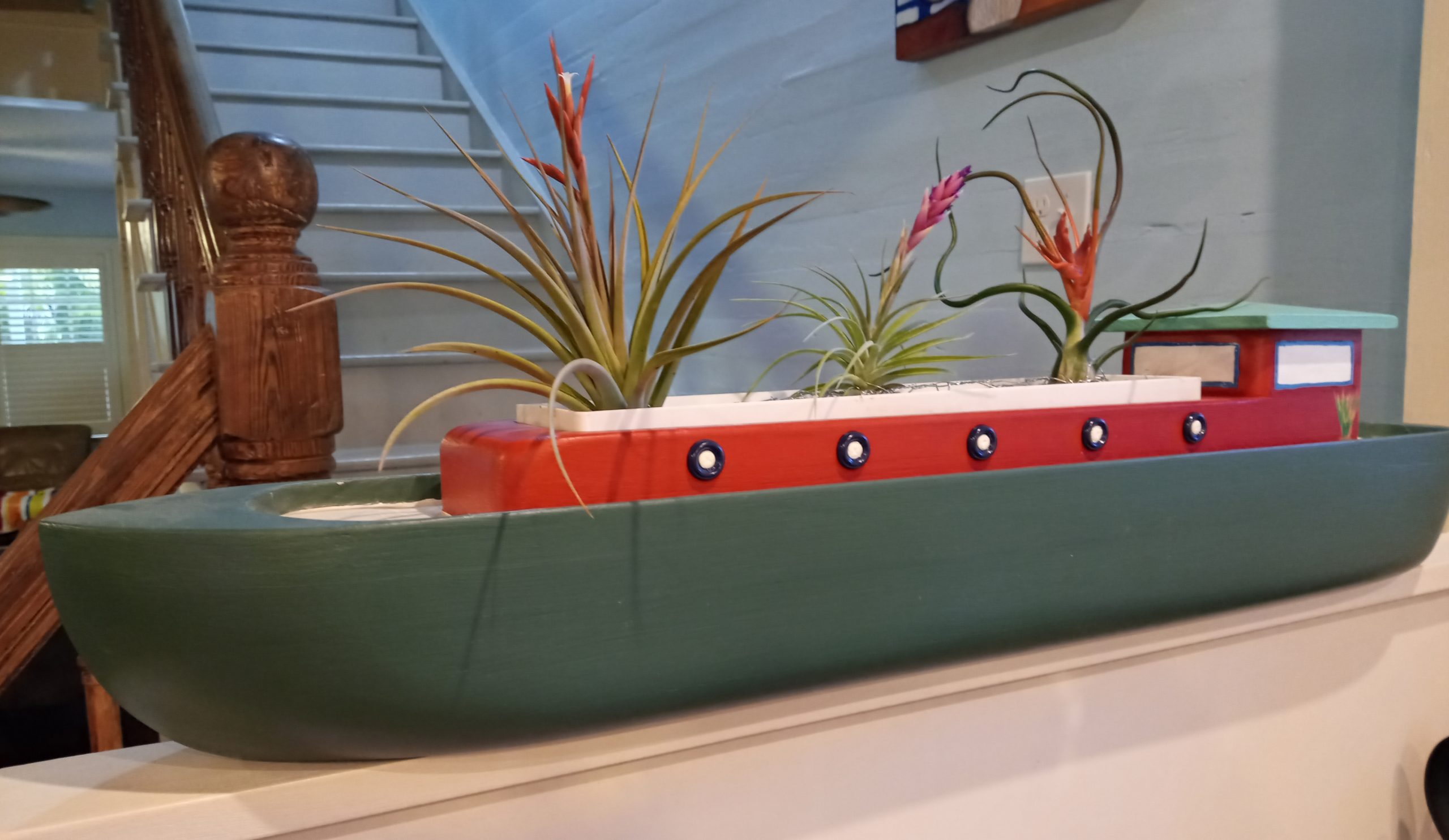
Now Jim is pretty taken by barges, my boat, and almost anything that you can live on that floats. He and Janice have had six houses, a ski place, a cottage and their place in Key West and while Jim thinks they might have a barge in the future, I think that Janice is going to keep them a bit more anchored to shore than that. She already has the challenge of keeping him anchored to reality.  We will see how that one pans out, but in the meantime Jim got it in his head a while back, to do a decoration for the front of their place in Key West that would be a wooden planter shaped like a Dutch live-aboard barge.

He made it out of ten layers of  2 x 14 cm (1 x 6 in) poplar, and then did some carving and shaping and some folk art painting. So today that sits at their place in Key West on the front porch when they are home and on the back deck by the pool, or inside when they are not.


So fast forward to last (2019) summer. When Jade and Jason were visiting their folks in KW in the winter  of 2019 they saw the barge that Jim had done and they thought that it would be nice to work with their dad and make one each. So the two barges they made were  a bit shorter in length and not constructed of the laminated  poplar but instead of 14 x 14 cm (6 x 6 inch) clear cedar and are fully carved other than the roof on the top. Jason is still working on the folk art painting on his so I will update this note when that’s done but Jade only has a bit more painting to do on hers.

I think they look great.

Jades Barge Planter


Jason’s Barge Planter

These days as we all try to self isolate, and are holed up in our homes everyone seems to be baking, painting, sewing, woodworking and generally doing all those things they have either been meaning to do (take up the cello) or get back to doing (making bread) so I thought I would share this little palette cleanser between my heavier posts.

Now where did I put that cello….

Django

SHEARWATER

POSTED: OCT. 1, 2020

I am not really a bird guy. But for the last few weeks a crazy big sea bird has been coming by and visiting En Plein Air. After pulling out one of my bird books I went over to where he likes to sit on the fore-boom and got up close to examine him with my book in hand. He twisted his head as if to see what I was looking at.

“Yup, you are a Shearwater” I exclaimed aloud. He just sat there.

Shearwater

Most days he comes by in the morning when I am out watering the little potted vegetable garden and herb garden I have. The first day he took away part of my toast, but left my coffee alone. Another day he ate part of Ciaras hard boiled egg. That just seems weird to me.

Now he appears to be hooked on the coffee. He sits not very far away and watches me. He seems to know when I have stopped drinking the coffee and there is just a little left and I have gone off to do something else its ok to get his beak in there. Both Ciera and I have started using wider mugs and not finishing our coffee and leaving the mugs on the table on the deck. I have also taken to getting out my camera and my bird friend has taken to picking up on that and flying off.


A buddy of mines parents moved to their cottage on a lake when they retired. Part of their routine was to go for long walks at dusk. A young fox got the idea this was a good thing and would come within sight of the cottage door and watch for them and they would watch for him before starting off. The route they took was always the same through some trails in the bush and back to the cottage and the fox would come and go and appear at various points on the walk as if checking on them. At times the distance from the fox to the couple was big and at other times smaller but never very close. By the end of the walk the fox would make his final appearance and then disappear into the forest again until the following evening in time for the “walk”.   In the spring, summer, and fall it happened during their walks and in the winter during their cross-country skiing of the same trails.

There is no big epiphany here, but just to say that these animals sometimes hang out for food and sometimes just because they don’t see people as a threat, and they find us interesting and its part of their routine.  I think they are a lot smarter than we give them credit for.

The two bird books I have, with a few cookbooks and letters are some of the only written luxuries I keep on the boat. On a regular basis I do go to local libraries wherever we are moored at the time however.

My bird books came out of a funeral I was at not many years after high school. I was back in town from working on the cruise ships and a friend’s dad had passed. I went to pay my respects and because I knew a lot of my old classmates would be there. Sort of a morbid class reunion.

His dad I did not know well – just a regular dad.  But at the funeral I learned of his interest as a teenager and then young man in racing pigeons. These “homing” pigeons were all the rage at one time. The owners would release them long distances from their home and they would make it back to their little pen with their own built in GPS programmed by Mother Nature.  At one time this was so popular that various “pigeon fanciers” as they were called would always have a spare safe spot or two for pigeons who were making it home from where they were released – a sort of pigeon hotel chain.

Because it was an Irish wake it was a bit of a scene. Two days before, the family had all assembled and the guys went out to the back garden and garage to build the rough box for the casket. With each saw cut or hammering in some nails they would tell stories of the fellow who had passed and have another swig of Irish whiskey, Canadian Rye whiskey,  or beer. My buddy told me there had been a lot of laughing, crying and drinking and while all this was going on the women were in the house cooking and baking for the wake and funeral day, and also laughing and crying and drinking.

At the time of the funeral there was a crazy amount of food, a lot of booze and a good number of people who had spent a couple of days reflecting on who the deceased was, what he meant to them and what life would be like going forward without him. So they were all well into the process of grieving and recovery, and quite reflective, while some of us, like me, came into it a bit unawares.

So when I asked a woman about the mans interest in pigeons she spent a bit of time telling me about Rollers and Tumblers, Dragoons, Black Grizzle’s and Kings and the ins and outs of the hobby. She was elderly and had known him when he was a young man and had shared the pigeon interest with him, but had largely lost track of him later in life. She knew of him so well and spoke of him in a such a way I think she might have been a girlfriend in high school.  And then she stopped and looked me in the eye and said of this dead old fellow who had raised homing pigeons as a young man: “His father was an alcoholic, and nasty to his mum and when be was old enough he left home in his mid teens to make his own life. The pigeons were a hobby but their desire to find their home is a sense that he shared with them.”

I was a young guy, and her sincerity and insight was a bit overwhelming for me and it has stayed with me for all these years. She was probably about the age I am now or maybe a bit younger.

A few days later I went over to see my school friend in a context that was more upbeat than the funeral, as I was heading off to the cruise ships again and the family was having a garage sale.

I bought two of the bird books and even though I have never really had much personal storage space, and even today don’t have much space on the boat they have traveled around with me.

The Pigeon, Wendell Mitchell Levi, 1945

They are quite old and tattered now, but unlike novels or other things that come and go with the fashion of the times, nature isn’t making new versions of these birds, so I can still look them up and find out a bit more about them, but every time I crack open one of these old puppies or even look at them on my little shelf, I think about that woman’s comments about the original owners of these books looking for home and think that in a little way I am helping these books find their own home.

Brocks Book On Birds, 1929


The book with the descriptor of this family of birds called Shearwaters had some pretty interesting details. These birds who share a general category with Albatrosses, are called Shearwaters (at least in English) as they like to fly so close to the surface of the water they appear to shear the tops of the waves.


They fly thousands of kilometers a year in migration and some dive into the water over seventy meters (over 225 feet) deep to feed on various fish. The book said nothing about them enjoying coffee so I will keep that to a minimum.


But its almost 9:00 and I had better get a bit of dry toast and some coffee and go and see if our new friend is on the railing of the deck waiting for me.

Django

p.s. The image at the top of the page is not my own. I have been trying to get a picture of my feathered friend but he has eluded me pretty well so this is an image from the Malta Tourist Office.

CLEANING OFF THE GUCK

POSTED: Sept 19, 2020

En Plein Air is an old wooden boat and the two key words here are old and wooden. There are lots of jokes out there about a boats just being a way to dump money into the water, and while that is somewhat true with new fiberglass and other composite boats, it is very true of old wooden boats. Now for those of you who come to this website often you will know that on the electrical and mechanical she is absolutely state of the art using a hydrogen generator to drive a super quiet electric engine but the rest of her, what everyone sees, is pure vintage boat. Vintage here I will translate: high maintenance. But keeping her up is part of the relationship, so we carry on.

When we were at work with various bookings most of them involved a sail, so she would get out to clean off part of the hull on a regular basis. But not this year. Other than our crazy dash to north Africa, and Cape Verde and back to Malta we have been at rest in Malta. The above water line stuff, largely on the deck, I keep up fairly well, on a rotation of small sections of wood that is tidied up and gets new protective coats, but the hull is a different matter. While it is a bit less of a problem when in use, regardless of getting for a nice good run in the ocean the buildup on the hull is relentless. It is easy to take her out under power on a calm sea for a little outing but a real sail is something we have not done in months.

Part of the problem is that this is not a nice boat to sail alone or even with two people. Modern boats are amazing in their ability to be handled by two people easily, but one like this I have seen Captain Sven, and Captain Ciara handle alone but its not pretty and at one point I had to do a run alone and that was just foolishness.

So the guck on the hull was starting to get to both of us. Partially because both Ciara and I love this old boat, and partially because in these stressful times we start to project out to the future with nightmares of eventually two inches thick of dense guck killing this creature we have been entrusted to look out for. This is not the only thing that troubles me when I think about the future but it is one that I am reminded of every morning when I get up and look over the side. When Jim and I discovered our same medical problem many years ago we challenged ourselves to be more like the other – him more laid back and me with a bit more focus on the future. Well, thanks a lot Jim. Now I think about the future, which I never did before, and Covid has put that into hyper-drive.

So when two talented lads with hull cleaning gear came by to ask if we would like to get the hull cleaned for fifty euros for each of six guys I jumped at the chance.

Where we sit is in a marina that is adjacent to a real shipyard. There are power hookups and pump outs, and showers and picnic tables and grilling units and some fire pits and laundry facilities. Everything is well kept and clean but not luxurious. In the office there are some basic services and for a fee we can do scanning and faxing and they have a pretty good wifi that covers most of the marina. And what’s nice is that adjacent to it is a real shipyard so in the event we needed a haul out that’s there, if needed. So it’s a nice set up but this is a marina, not a yacht club

So these two enterprising lads had spent their summer off university doing hull cleaning. One of them has an uncle with a big live-aboard trawler that in exchange for cleaning his hull once every six weeks gave them a snuba system. If you have not seen one of these it’s a pretty cool rig that has an air compressor that sits on a small zodiac with long air hoses to feed multiple regulators so “divers” can go down to about 30 feet with an unlimited amount of air. You are still tethered to the zodiac so for experienced divers I think it would feel freakishly restrictive but for applications like this it is fantastic. So they bring as many other guys as the size of the boat warrants. For En Plein air they brought an extra four.  These two guys do the underwater cleaning with big waterproof oscillating brushes (think electric toothbrush’s for dinosaurs) while one fellow mans the zodiac, and gets them whatever they need. Two other guys sit on semiboyant “chairs” in the water cleaning the waterline that gets the worst of it, and one fellow is running around on the deck and at times at the water getting the other guys gear and repositioning things

It was pretty impressive to watch, but I was spending my morning prepping for lunch. The deal I had with them was the pay of course but they had said they could probably have it done by 1:30 or 2:00 if they started at 7:30 and I had said I would serve them lunch and then we could all go for a sail and really give En Plein Air a chance to run.  All six of the guys are sailors.

So what do you feed six hungry guys after working for a “stretched” morning? Fresh homemade pizza. With one oven with three racks in I could do three pizzas at a time and at 450f the oven time is less than twelve  minutes so in doing seven large pizzas it was all about the prep.


I sometimes make my own dough but not often. Most good ports will have places to buy a prepared fresh dough and I just put my time into the toppings. These days I don’t use peperoni but have opted for turkey kielbasa. The veggie ones are sundried tomato, artichoke hearts, mushrooms, and capers but in each case lots of herbs and a nice drizzle of olive oil and a brushed oil edge and sitting on a scattering of corn meal.

I have had a long relationship with Pizza. When I was a teenager, just a bit younger than the guys working on the boat, a number of us worked at a pizzeria called Cicero’s in Ottawa, Canada. The term worked is one that involved one or two of us with shifts and the rest of us hanging out in the place much like those leeches at Starbucks who arrive early with their laptop and buy one tiny coffee and stay all day at “the office”.

Eventually all but one of us were not only fired but were also banned from entering the place. I think the guy who ran it was partially upset with the decline in business as the general market conditions for “real “pizza as in the early 1970’s frozen pizza at the supermarket was a simple way for busy parents to cook dinner and a lot of people stopped being prepared to fork out the extra cost for something edible.

The following summer three of us worked for one of the guy’s dads who had a signage shop. We came up with the brilliant idea to make decals to put on frozen pizza boxes as a bit of a prank. I can’t remember how many we printed but we were able to sneak most of them onto the frozen pizza boxes for sale at our local grocery store.

There was a little trouble with the grocery store owner, and with my friends dad for misusing the decal machine, but it was sufficiently funny at the trashing of the quality of frozen pizza at the time that the fellow who had Cicero’s eventually forgot the ban on us and we could go back to buying pizza there and even hang out a bit.


Ah, but back to the pizza at hand.

With the range working at such capacity I did not have a way to heat the plates which is unfortunate, but Ciara had enough chilled beer on hand that the guys were happy.

The six lads did a great job but both with us, and working together they had to be reminded about the two meter rule and none of them had masks. Over lunch we had a bit of a glimpse of their perspective on this pandemic. At least two of the guys saw it almost as a joke, and only one took it at all seriously. Everyone saw its potential to harm but at ages like 19 to 22 they all found it hard to really respect the power of this virus.

Only two of them said they had any real conversations with their parents about the future which seemed strange to me until I remembered the inane conversations about movies or sports I would have with my parents instead of anything meaningful. Every day is a new one for them, and the vision of the future is more focused on what they are doing right then, or that night, not the years to come.

Both Ciara and I are painfully aware of how this virus could strip away a year or more of what are not a lot of really active years left. That idea that when shared, came as a major epiphany for these lads.

En Plein Air

Because we follow these covid protocols pretty literally Ciara had planned for our afternoon sail to be based on a “station” style where each person doesn’t move much from where they are “stationed” but with this bunch that all broke down but at least they gave her and me some space.

This post might not be as interesting as some, but for both Ciara and me it was a significant day. We watched some hard working lads do a great job, cleaning away the guck on the hull and cleaning away some of our anxiety with it.


En Plein Air had a good run that afternoon and we came away with an understanding of how this current pandemic is (not) affecting some people, while most people over a certain age are totally anxiety ridden, almost incapable of performing basic functions and waiting for the end of the event to come.

It reminded me of two similar situations at two very different times. Janice had a military dad who was seconded to the U.S. military (from the Canadian Forces) and they were living in Key West during the Bay of Pigs and Cuban Missile Crisis. All the school kids were told that if they heard the sirens to get under their desks and to stay there until someone told them to come out. They did drills for this regularly.

The other situation was related to me by a woman I have gotten to know in recent times. She is about ten years older than me and shared that when she was a little girl during the war her father was a scientist and they lived in “The Secret City” of Oak Ridge Tennessee, and her father was one of those scientists working frantically on “The Project” -what we now know was The Manhattan Project.  At the schools in Oak Ridge they told the kids (even really young kids) that if they heard the sirens they should immediately run out of whatever building they were in and up into the wooded hills surrounding the town, find a large tree and to hide behind it facing away from the town. They were told that when it became safe again someone would come to get them.

So like everyone else right now, most of us over a certain age once again are under the desk, or behind the tree, holding our breath figuratively and literally. I don’t know who that someone is – a smart millennial at Oxford or Harvard or in Mumbai or Beijing who finds the path out of this, or maybe the someone is us individually in our behaviors, or our collective selves in respecting others?

But getting the task of cleaning up the hull completed, watching these young guys truly love the pizza and beer, and reminding us that perhaps one day at time is ok at times, was in itself a way to dial back the anxiety.

Django

GABRIELLE: META & METAPHOR

POSTED: Sept  1, 2020

The evening started simply enough.  Over these months in a little marina bubble, I had been getting to know both Martha and Malcolm over our various encounters when the very private Gabrielle and Gerhardt asked if there would be a way for us to mix things up a bit and all have dinner together on shore. While we had experienced dinner “together” a couple of times before it had been on the boat dock and we were at a distance both physically and more significantly on sharing thoughts. I had not been stressed by this – I have known a lot of people who are just very private, but when the idea of dining together was raised by Gabrielle I must have looked shocked as she asked me with her pleasant German accent “shoe di call da cardiologist?”

Gerhardt was in charge of the fire pit, Gabrielle and Ciara organized the dinner plates and cutlery and cleaned the picnic table, I prepared and cooked the dinner and Martha and Malcolm brought the wine and wisdom.

Without getting too far off track here let me tell you a bit about the meal.  I love to work away on my own recipes but sometimes I will come across a dish by someone else that I might tweak a bit but it is so damn good I just find it hard to improve upon.

Because we were going to have this nice fire in a fire-pit, and I did not have a lot of lead time I did a recipe by Jamie Oliver that is a real crowd pleaser. This lad nails it so often and this is one of his best, simple, fast meals that never fails to please. It is also one cooked in foil so it lends itself to cooking on an open fire, gas grill etc. if you are outside. I love the fact that you can do all the prep ahead and then just be with everyone else enjoying the conversation and when its ready you just unwrap it, serve it, and that’s it.

The recipe that follows is straight up Jamie, not Django and my variation is there as well. I have put in the directions for using a regular oven as my “fire pit 200 c (400 f)” may be different than yours!

————————————————-

SALMON ON GREEN BEANS IN FOIL

Salmon on Green Beans in Foil

You will need whatever number of nice-looking salmon pieces for individual servings and a lot of green beans. By a lot what I mean is that the main dish here consists of green beans and a piece of salmon so a good single handful of green beans for each person. Wash the green beans well, cut off and discard the stems, and set aside to dry. If you are doing this with a range instead of a fire pit preheat your oven to 200 c (400f) if you are going to be cooking them right away.

Pull out about two thirds of a meter (yard) of foil and fold it over to double the thickness. Place a nice handful of green beans for an individual serving – not organized like a haystack or Boris Johnsons hair, but like logs ready for the mill, side by side, and a few rows high. Place a piece of salmon across the beans (skin down) then put on a good dollop of basil pesto. If you are well equipped and in the mood you can make up your own pesto with basil, roasted pine nuts, olive oil but for most of us, a high quality store-bought pesto can do the job. The squeeze of a lemon, some salt and pepper, and a drizzle of olive oil on top and you can fold up that foil container and repeat for the next one.

Salmon in Foil Prep

It does not take very much time at all to put these together. Put those in the fridge for cooking later if you’re not cooking them right away. This is uncooked salmon and it would be a terrible thing to die during a pandemic of something other than Covid 19.

So that is probably the best place to introduce Django’s Kitchen Rule #4.  With a dinner that would need to be carried a distance to the fire pit and where we would be sitting, and Gabrielle’s desire to open up to us a bit I did not want to miss any of the conversation running back and forth to my little galley kitchen. It was those factors that led to the choice of the salmon on green beans that could be prepared ahead, easily executed without much effort and then platted right at the firepit meant that I could do a more elaborate starter, again all ahead.

Django’s Kitchen rule #4: TIME MANAGEMENT IS AS IMPORTANT AS THE INGREDIENTS.

My situation cooking on a boat where I am trying to minimize the heat from the stove and where I am working with only one stove of course and only limited counter space has me usually scribbling down a little time-line ahead. The other key component is to convert everything that is to be cooked to a standard cooking temperature. With that done it is simply a matter of working back from when it is to all come out of the oven at the end. So for example I might set a timer for forty five minutes if that is the time for the component that cooks the longest (eg. Meat or root vegetables), and then at various points over that forty-five minutes you will put in other foods that take less time. It is not perfect and sometimes you will need to take one component out a little early as it is ready and just keep it warm but for the most part this technique works well for small one range kitchens.

In this case I had decided to add some nice little (golf ball size) roasted potatoes around the edge of the plate so I washed them up, let them dry, cut them in half and mixed them with some olive oil and fresh cut rosemary and some thyme, and seasoned them with salt and pepper, and they all went into a foil packet as well. If doing it in an oven I would have put this not in a packet but just in a flat pan or baking sheet into the oven during my preheating process as small potatoes you have not blanched will need a bit more time than the salmon.

So if you are doing this in the oven, get that pan with your potatoes in there, start to preheat to 200c (400F) and when your range gets to temperature pop in those salmon and green bean packets for fifteen minutes if the salmon pieces are thin and about twenty minutes if they are thick. At about the half way mark turn those potatoes over with a spatula or if doing them in an aluminum packet on the outdoor grill or spit, turn the packet over but leave the salmon packets upright. Another little tip – if you are cooking on a fire pit, its not a bad idea to move your pieces around a bit just so they get cooked evenly. After the fifteen or twenty minutes get them off the heat and let them sit for a couple of minutes, then pull apart those packets and plate it up.

But the really simple thing here is prep what you can earlier in the day. Clean up your kitchen and your tools and it will set you up nicely for the main event.

And I told you at the beginning of this piece about the variation I like to do. Some people are not salmon fans so for them and without adding too much complexity to my prep I will use a meaty white fish like Mahi. For people who are not fish fans, its not flakey or oily and has a density closer to lobster than most fish. I match that with not the traditional basil pesto but with a tomato pesto and still on that nice bed of green beans. I don’t have good image to put in here but will come back and put one in the next time I make this dish.

And if I have any vegetarians in the group, the salmon is replaced with a couple of big, thick slices of Portobello mushrooms, with no pesto but a little pat of butter on top. Sometimes to liven that up and make the vegetarian meal have more flavors I will also put a several grape tomatoes mixed into the green beans and give the whole thing a heavier drizzle of olive oil. There have been many a time someone presented with the salmon will clearly have a look of “damb, I should have had the vegetarian option!”

For most dinners when it is not a big entertaining thing, I usually put most of my efforts into the main course and will often not have a starter or just do a simple green salad or caprese salad. This night I was actually planning on doing a simple caprese salad with my fresh tomatoes and Basil from my little deck potted herb garden and making some nice bread sticks with it, but decided because I had the time and had purchased some local beets and the arugula in my little herb garden pots, on the deck had gone from baby to full size to monster I changed course and went to a beet salad instead.

To prepare a simple beet salad, the only real exercise is cooking those beats. You will need one large beet for each diner. Cut off any tails, give the beets a fast wash, put them in a pot with them completely covered in water and get it to boiling. Then turn it down to a little rolling boil and leave it for about half an hour or forty-five minutes. Then drain off most of the water leaving about 2cm (3/4 inch) of water in the bottom and transfer to a stove at 70 – 100 c (160-200f) for an hour or so. The test is when the beets can be pierced easily with a fork. Then drain the water off and scrape the outer layer of the beets off with a knife or spoon.

Beet Salad

It will come off really easily but best not to be wearing your chef whites when executing this!  With the beets done they can be put in the fridge for later when you are assembling the salad. Much like the salmon packets you can do this messy step ahead and just pull out the beats close to the time you are going to have dinner.

For assembly, simply cut each beat in slices about one cm or ½ inch thick. Place on an individual plate for each diner, throw on some washed arugula, some feta cheese and crushed walnuts. Drizzle on some reduced balsamic or if you don’t have any, just some olive oil and balsamic, give it some salt and pepper and you are good to go.

The idea of the breadsticks had slipped my mind so some nice toasted rye bread was the substitute. One day I will set out the breadstick recipe but for now, I need to get back to my story.

—————————————————

It turns out that Gabrielle, in addition to being Gerhardt’s life partner and business partner in their jam business is also something of a crazy artist. Now I have known a few artists and they come in the full range of types of people and there is a full spectrum of artistic mediums for them to explore. One day I will do a piece on Janice’s work which is a pretty cool, hard edge, sort of Victor Vasarely style. You can see her work in the Links We Love.

Gabrielle’s work is influenced by her background in art and industrial design, and is full of mental twists and the art is the starting point for discussion. The piece that triggered this part of the conversation that night is one that I had seen her working on for a couple of weeks.

She had taken an obsolete laptop and with her Dremel tool had cut out those pesky electronic components to create a space for a conventional paper notebook and pen. So the laptop becomes a briefcase of sorts for the low tech paper and pen. She claims it will never have a virus. It is a bit of a response to back to simple tools in a time when everything is anything but simple, and it is also something of a withdrawal from, or response to, the technologies that dominate our lives.

Minimalist MacBook

And yes, that is a wireless mouse in the picture.

Laptop with Pad, Pencil, Delete Device & Wireless Mouse

Over the course of the evening Malcolm made various trips back to his boat to get more wine and as the evening wore on, we learned more of Gerhardt and Gabrielle and why they were in this little harbour with us.

It seems that many years ago Gabrielle had cancer, beat it, and then it came back in a different form, and she beat it again. She is a very tall woman in her fifties and is hopelessly fit – she runs, she swims, she works out, she does yoga.  But the various bouts with cancer and the associated therapies and chemical cocktails have taken their toll. They sold the jam business and were on a bit of a meandering world sail when Covid hit.

Like most of us at this marina, they had been moored off the little island of Gozo, or the even smaller island of Comino where the water is clear, the seclusion is conducive to naked swimming and the beaches are nice. But Comino has very few facilities and while Gozo is a pretty complete little place on its own there are more resources on the main island of Malta. In our case only the main island had a good source of methanol for our generator that powers En Plein Air.  So like us, when hunkering down for an undisclosed period of time a better equipped location was on the big island. By the way, Comino is the location of The Blue Lagoon, the Crystal Lagoon and a variety of interesting caves. It is a great destination anytime other than during the summer crowds.

Rudder

Over the evening she also showed us another project that I had also seen her working on. It was an old rotted out wooden rudder that was left at the marina, from some small sailboat – probably about a three or four meter (12-16 ft) dingy format.  She had fabricated a new laminated rudder in mahogany and maple to match the old dimensions and fittings. It has no current purpose, other than as a decoration on the wall as a nice object, but true to her other art pieces it is a metaphor – you can’t do much on the water or in life with a broken rudder. 

This post is pretty long so I wont detail the discussion flowing from a question raised by Martha but actively engaged in by Gabrielle and Ciera, about whether waterproof glue or conventional glue had been used for the wood fabrication. The gist of it is whether she (the rudder) would hope to see the water again (requiring a waterproof glue) or whether her new life with regular glue, and hung on a wall,  she would be satisfied as an admired object, but with her sailing adventures relegated to her past. After the first ten minutes or so it was clear the glue was only the catalyst for this discussion and Malcolm, Gerhardt and I  just sat back, drank wine and listened.

Related to this, Malcolm and Martha shared a story about a recreational carpenter friend who keeps an old level that has lost its liquid (so no longer finds balance) and also keeps an old steel square that is bent. He does so because these tools, hung prominently in his workshop, remind him that we all need the right tools in life. The carpenter also has them around to keep him humble. I need to spend more time with Martha and Malcolm. Between the two of them, with their knowledge and experience, there is not a lot else to know.

At about midnight, after too many smores and just about the right amount of wine, Gabrielle told us of her more ambitious and ongoing art project.

Gabrielle has a real expectation that while she is “remission”, she only has a fixed amount of time left on the planet. For some people that idea triggers them getting out to do all those things they have always wanted to do. For others, its more a matter of trying to firm up the memory of what they have experienced over their life.

Gabrielle seems to be in both camps, so this stop in Malta, because of Covid, is part of their “big adventure sail”, while she tries to document her life with Gerhardt and their two boys.

For most people that amounts to putting together a scrapbook or USB drive with images from our past. Not Gabrielle. At one point in Berlin where they lived for a while, she had gone back to art and industrial design school, and had held in the back of her mind an idea of how to record your life but had not acted on it until recently.

Pinoccina 2

It had been an extension of seeing some art while on a university trip to Budapest. She had gone to an art show of recent graduates at an art college there and was inspired by one young artists work.

This young Hungarian student from Pec had found at a fair, an old life- size moveable marionette who looked much like herself. She made some modifications and changed its hair and made the marionette up to look like herself and then put it in all sorts of situations she would usually be in – having coffee, watching tv,  on her bike, in a hammock.

Now here is the crazy first coincidence. That art show and that artists work I had seen the final project when I was visiting Hungary in September 2009 as well. It was called Friss, (Fresh) 2009.


Pinnoccina

Artist Gajcsi Blanca relaxing with Pinoccina, Budapest, Sept 2009


So inspired by this artists’ project, Gabrielle, who had just recovered from her first bout with cancer, had hired a sculptor to make molds of all of her body pieces, had them reproduced in carbon fiber so they would be light and strong, and then created the engineered joints using a 3D printer to make this mannequin a duplicate of her. Did I mention she was German! LOL. The project was completed over several years and after her most recent medical challenges she completed the “doll” and brought it on their epic cruise.

She dresses up the mannequin and has been taking pictures of this copy of her in some cases doing things she is not prepared to risk -hanging off the Eifel tower in Paris for example. But this has a bit of weird twist as well – she has taken pictures of Elle, that’s the mannequins name, in bed with Gerhart, with some really garish makeup and outfits etc. She is kind of acting out with this character. Gerhart is a pretty good sport with all of it and is just happy to see her engaged in a project and not focused on the nasty nature of the term “remission”. It’s also a way for her to start to distance herself from her body, as in recent times her body has let her down.

So that’s the second coincidence here. When Jim and I met again after all those years in that neurologists’ office (for those who have only come to this website recently, check out the ABOUT section), it became pretty clear that we each became the others mannequin – both trying act a bit like the other without either of us committing to go to far, but just far enough to manage our mental health, to feel connected, and perhaps to live a little longer.

Malcom put it pretty well that night: “We all want to be loved and we all want to be remembered.” I told you he and Martha brought the wine and the wisdom.

It was a great night and Ciera and I  learned a lot about Martha, Malcolm,  Gerhardt and Gabrielle, Elle, and ourselves.

Django

P.S. Gabrielle is pretty private about her Elle project so while she was prepared to share it that night and let me talk about it here, as well as letting let me include pictures of her laptop and her rudder projects,  she did not want to share pictures of Elle.

Also, the images earlier about the art of Gajcsi Blanka are mine, but please, if you are reproducing them, reference the artist. Check out her current art at: gajcsiblanka.hu

WHAT WE CAN LEARN FROM PETANQUE

Posted: August 1, 2020

Now it would be easy to think that I never leave En Plein Air, and that is largely true. But sometimes I do leave to get some exercise, and do some chores. During Covid 19 I am largely on the boat, on the marina slip or in the nearby park. I keep two really nifty and horrendously expensive fold up bikes on the boat, courtesy of a British couple who thought they could run out without paying their bill after a four-day weekend last year and forgot to take their bikes. I still smile at that bit of justice. So I get out on one of those sometimes.

Yesterday I was at the park beside the marina and playing Petanque with Ciera and it got me to reflecting how much that game is a metaphor for our current times. If you don’t know Petanque it is game played like the much better known ball game of Bocce. The scoring and many of the rules are the same but the key difference is that the Frenchman who came up with this fairly new (1910 ish) game thought of, in contrast to Bocce is that you don’t need a court. Bocce is played on a nice level court with little walls you can grace the ball off, and the predictable surface, and consistent width and length or court, makes playing it a skill. Watching talented Bocce players coax that ball around other balls on the way to its destination close to the little Cochonnet or Jack ball  is a thing of beauty.

And just to stay with Bocce for a minute the image below is a bit whimsical. When I was in Key West visiting Janice and Jim last time we went out to their local Bocce court and played a game. In Key West, play is regularly interrupted for either the feral chickens running through or one of the huge iguanas sauntering across. Crazy place.

Iguanas at Southernmost Bocce Club, Key West

So Bocce, and British Lawn Bowling for that matter is this refined pastime played politely on tidy courts. Petanque in contrast was invented to be played wherever you have the space – on gravel, on grass, with a slope or even on sand. Steel balls about the size of tennis balls are used instead of the larger resin Bocce balls.  Petanque is not as much a rolling game as an underhand throwing game to get close to that little Coche or Jack ball.  There is significant skill involved of course in getting your ball to fly through the air to get close to the target, ideally with a little backspin to keep it from rolling too far, but because it is played on an irregular surface that irregularity is a great equalizer.  Just a little bump in the ground from a root or stone can humble a good player. So in that regard if Bocce is chess, Petanque is backgammon with that roll of the die to add an element of chance.

Parenthetically I should add that I think to play Petanque according to true French tradition you must have a baguette, some cheese and wine also on hand. This also equalizes the quality of play!

The use of a beret and French sailors stripped shirt however will just get you laughed at.

So why do I think this is a metaphor for our current times? Well, Bocce is predictable. You do certain things in a disciplined way and the outcome is pretty easy to forecast, even if the chickens and iguanas have messed up the court a bit, because once they pass, things are largely back to a normal surface. So in life, you study or learn your trade, you work hard and employ good discipline and behavior and pretty regularly your career or life works out.

Petanque has that crazy bumpy surface with roots and stones that makes every throw a new adventure. I think that is where we are right now.  Some have hit a nasty bump and lost their incomes, their jobs and in the extreme cases, their lives. Some have had their business fail that not only takes away their livelihood but their nest-egg and crippled their plans to sell the business and retire one day. Some have hardly noticed the effect of this pandemic financially and are just enjoying so much take out food. In general it has been very bad for the poor but randomly unpredictable for everyone. I see it here with some losing their boats, while others are excited by the buying opportunities,  and for some a certain thinking that with the world at an end – anything goes.

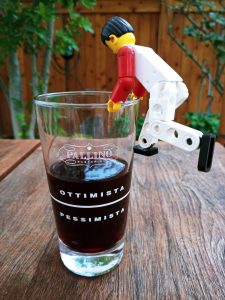
OTTIMISTA

The only stocks I buy are stalks of celery, but when I hear people in the financial worlds talking I know that the conventional wisdom is that in a down market you buy to get your average cost per share down and your dividend yield up, and in an up market you sell to harvest the yield from your earlier good buying discipline. But this may well be a different time. Some will benefit I am sure from that old strategy and some of the “smart” money will do well but just as some people made money in the early days of tech and the early days of legalized cannabis, some lost everything in both of those sectors.

Certainly it is a time when lots of people are experiencing some changes in their lives that while not positive, have some positive elements and ones they never would have experienced voluntarily.  Slowing down, spending more time together, evaluating what is important in life are all things we see happening all around us, and those are positive trends.  The most common response I get when asked what someone will do when this is over? Hug a friend.

PESSIMISTA

I think any of us who chose to continue on the planet are at some level optimists. But I also  think that most complex things are not as binary as that.  We may be optimists on personal growth and pessimists on financial security. Or pessimists for the short term prospects and optimists for the longer term. And those of us who are on the wrong side of a certain age have seen enough to be cautiously optimistic, or pragmatically pessimistic. Experience counts, and some of us have the knowledge that we don’t have the time left to get some of this wrong so we may be quite positive in attitude but make decisions to protect ourselves if we are wrong.

This post has truly been a bit of ramble, but I think we can learn a lot from the game of Petanque.

Django

JULY 7TH 2005 & THE CHEF UPSTAIRS

POSTED JULY 7, 2020

Most people can remember where they were when the planes crashed into the World Trade Center in New York and the associated ones at the Pentagon. Most of the citizens of Europe and the certainly the U.K.  also know where they were when the London tube and various other locations were the subject of terrorist bombings on July 7, 2005.  That was fifteen years ago today.  Janice and Jim certainly know that second one well. They were on one of the bombed trains close to Kings Cross, two cars back from the bombing and had to walk out of the tube and then through the chaos, up to ground level. They were a bit dazed and confused (well that’s not unusual for Jim)  and once out of the tube station walked a long way until they could get a cab for a luncheon with chef Jamie Oliver at his Fifteen restaurant. They were on their way to see the place, meet Jamie and to run a crazy idea by him. That lunch occurred, and the rest of this piece is the story of what led up to it and what happened after.

When people retire, especially if they retire young, they are “full of piss and vinegar” to quote my aunt. For the first time they don’t have to worry about paying the rent, or mortgage but still have the energy to do things and often have a pent up demand to pursue some interests.

On Jims 48th birthday, January 24, 2002 he retired. Yeah, how rude is that. He did not retire wealthy, but was able to retire at that age and had a lot of things he wanted to do. One of the long list he had was going back to school – cooking college. While the college was known mainly for turning out chefs, him main interest was not actual cooking classes but the investment side of the restaurant business. He wanted to understand why restaurant businesses fail at an even higher rate than most small businesses do.

What he learned was that there are essentially five reasons restaurants fail. The section THE CHEF UPSTAIRS details these elements. His goal with this food based business was to solve for each of these variables and design a business that would reduce these five risks.

So in 2004 Jim set out to find a building to buy to renovate the second floor for this purpose. He found one on Mt. Pleasant in Toronto, bought it,  designed the space, designed the website, designed the logo, put together the business plan and the design for a two storey addition to accommodate the needs of the operation. This also involved the renovation of the ground floor for a second user in the building to pay rent to reduce overhead, and securing  the permits and approvals. And of course – building it.

During this time he and Janice also went touring around to see various chefs to run the concept by them. One such outing was to London to see Jamie Oliver, which I referenced at the beginning of this piece. Jamie was a little startled about the crazy morning they had experienced with the bombing but was very gracious and they had an exceptional lunch and conversation.

Jamie, Janice & Jim, July 7, 2005 London

The trip sounds extravagant to just go for lunch with Jamie Oliver but it was actually part of a trip to visit their son Jason who was doing summer studies at the University of Edinburgh and at Trinity College Dublin. So the trip was a bit of business but also visiting Jason in his last days at Edinburgh then traveling around Ireland and linking up with him again in Dublin to take him and a a friend out for another dinner.

As most things in their lives Janice was an important part of the design, and execution of The Chef Upstairs, but on this one Jim used the opportunity to teach Jade Autocad for the design work, and worked with Jason on part of the construction.  By spring 2006 they were opened.

So from 2006 to 2008 Jim ran it with a chef and tweaked the operation. Some events were as small as two people for a wedding proposal dinner, but more often the events were regular demonstration style cooking classes on various themes, sometimes corporate dinners where privacy was a  key feature, and often hybrids of this where the cooking class participants would be shown  the preparation of  a multi course meal and get to dine at the same time.

A big attraction was that because the space was only for the group that day or night, the tablecloths, napkin folds, music, and décor could be tailored to the group. There was also orchestration in the schedule where a group for example might work out a plan with the chef to have champagne and canapes on arrival, then have a little gap when someone would give a speech, then a first course followed by a presentation etc. For family get togethers the chef would duplicate grandmas famous chicken pot pie, or her apple crumble as best he could and do it in one of her dishes to make the whole thing a great alternative to having an event at home.

By 2007 it was successful, but by 2008 it was turning into a job, in contrast to a fun challenge, so Jim bought another building to do a second location on Queen Street in Toronto and found a buyer for the operation so he could build out locations for the new owners and rent them the space. Nice plan, but then the 2008 financial meltdown occurred. The new owners, were able to continue with the first location but could not expand.

Fast forward twelve years to 2020 and the business still continues under the skillful hands of the brother and sister team of Greg Heller and Lori Heller, who were the buyers at that time, and they have added a hands- on second location for cooking classes.  You can check out the current operation at: thechefupstairs.com

Ah but before I leave you there is a bit of a corollary to the Jamie Oliver story. While it had always been hoped that Jamie would fly over to Toronto one day to teach a class at The Chef Upstairs, that did not happen. What did occur however was that he did a book launch at the facility. Good on ya, Jamie. A couple images follow.

Jamie at TCU 1

Jamie at TCU 2


So that’s the story of what happened to Janice and Jim fifteen years ago today on July 7, 2005 and an introduction to The Chef Upstairs. I am working on that little section of the website to detail it a bit more than this as it was a big part of Jims life for a few years. Look for it in the next couple of months.

Django

COVID COMFORT FOOD

Posted: July 1, 2020

It is a bit strange that I am busier than ever when not allowed to do anything, but that seems to be the case. Jim has me working on the TorontoART section for this website and getting my input on the “shopping cart” that he keeps assuring me he is working on for the website as well.

I have also been collaborating with him on a course he designed when he and Janice had the cooking school The Chef Upstairs. It was called College Survival and it was an introductory cooking course for young people. I have had several emails asking me to do something like that as many people are cooped up inside and it’s a good time to move forward on personal pursuits.

So all that business is in the works and I am playing hooky from all of it to write a quick post on Covid Comfort food. I just thought I would put down a few thoughts from a meal I made for the little group I am now cooking for every day.

It has turned into a pretty good routine. A couple just down the dock I don’t think have ever cooked before. They are wealthy Germans.  Their routine before Covid 19 was to just go out to lunch, go out to dinner and much of the time go to a local bakery and coffee place for breakfast. The only appliance I have seen them use in their huge trawler is the fridge and the corkscrew but they told me they recently bought a coffee maker. They seem like nice folks but are just coming from a very different world. So they have an online grocery delivery service that they order online what I tell them we need. The grocery service buys the stuff, puts it all in a pull cart and brings to the dock to En Plein Air and I put away the food components other than some breakfast things and things like toilet paper and the two other couples just take away their respective bits.  The German couple pay for all of it and I make the breakfasts, lunches and dinners for Ciara and me, this older couple Malcolm and Martha and this German couple.

Malcolm and Martha order and pay for a case of wine each week and four bottles come our way and to the other couple each week and Malcolm and Martha have the last four. So our food costs are covered, our wine is supplied and all I have to do is the cooking – suits me!

A couple of times we have all eaten together while social distancing but most of the time Cierra just drops off the meals and we all eat separately.  I don’t know if I will ever really get to know the Germans, Gerhard and Gabrielle as they are pretty quiet and even more private. About all I know is they own, or once owned, a jam company and are generous.

In contrast I am really getting to know Malcolm and Martha and they are pretty cool Americans. They have a few more miles on them than I but they have been miles that have not been wasted. That may be the trick to life. I am rambling a bit here but you will see  their names come up again as  for me at sixty six, to spend time with someone like Malcolm who is almost old enough to be my dad  and not just my chronological senior but still able to be (by a far margin) my mental senior – well that’s something.


Now “comfort food” means a lot of different things and its really whatever meals or tastes we have in our memories from when we were kids for the most part. A safe time in a safe place with our folks who made simple, easy to prepare, and often inexpensive dishes usually from rote, and always adapted for the tastes of the various members of the family. Depending on what their cultural origin, those meals were usually ones that had been passed down from their parents and adapted to current tastes.

The French are damb good at it – all bistro food is comfort food. Steak frites, cassoulet, or the French Canadian tortiere – the list goes on and the mouth waters. But the French version of comfort food to do well still takes more effort than the average person is willing to muster.

The Italians are the ones who just do it without thinking. Almost every fancy Italian recipe has a simple rustic version that takes little skill, and as long as the ingredients are fresh can hold up against the most sophisticated dishes.  I will come back to fresh in a minute.

But for some of us, while we love all sorts of comfort food, the Brits have it nailed in their pub grub. Shepherd’s pie, fish and chips, well you get the idea. Now for those of you who have not been to the U.K. in the last couple of decades the real trend is the GastroPub. These are the places that the likes of Jamie Oliver got their start. They typically will do a modern take on a traditional dish.  I was in Scotland about ten years ago and in one pub the most popular thing on the menu was a Grand Marnier infused Haggis. Now if you can take on Haggis and win popularity you deserve to have a museum named after you.

So comfort food at a time like this is not only appropriate because it is a familiar thing in unfamiliar times but it also often uses food products that are readily available and ones that are easy to keep in a cold cellar for a long period of time. Just a nod to you hoarders out there.

Today many of us are returning to locally grown (200 km or 100 mile) produce. That means in most cases seasonally produced produce.

This is probably the place to introduce DJANGOS KITCHEN RULE # 3. SHOP FRESH, LOCAL & SEASONAL.

So the shopping fresh part everyone gets. The most basic of meals when made with super fresh ingredients blow away something that has “ripened” in the back of a truck over a longer period of time.

The shopping local is a good goal and one I try to live by, but it is tough, particularly if you are in a northern climate.  A few generations ago, if you were living in Europe or the northern half of North America no one thought of having bananas in the winter. It is even more extreme for those who live in even more northern climates – for those who have not noticed, the banana growing season in Norway is REALLY SHORT.   LOL.

So before refrigeration and inexpensive transportation were popular, if you were eating locally grown, it meant you were eating seasonally grown food and you start with the first harvest or unheated greenhouse harvest in the spring, gorge away all summer and put a few extra kilos on your gut and by fall would be preserving like mad and putting away root vegetables to survive on through the winter. So in winter you would have marmalade but no oranges and jam but no strawberries.  Most of us were not keen on the food habits of farmers in Victorian times so these ideas, while good ones to try to adhere to, are not realistic for most of us who value a good, well balanced, nutritionally correct diet today. So we buy fresh when we can, local when we available and buy the other imported bits as needed.

I have found that Covid 19 has made me think a bit more about these issues, partially because of shopping less often to reduce our exposure. Now that we have the arrangement  with the German couple it doesn’t matter as much but before that I was pretty spooked about the way we had to shop – flying through the store with a mask and gloves and not looking at whether the tomato was ripe or wizened and then trying to eat the fresh, very perishable produce first, and the longer life produce later in the week. It is the same with people who head off for an across the ocean sail – you can’t order a pizza when mid-Atlantic.

So If you are shopping every eight or ten or twelve days what does that look like?

Well, you buy some yellow bananas for now, some green bananas for later and some apples for the last few days of it.  Similarly, on veggies it’s the fresh green beans or French beans for the next few days, the broccoli after that and the Brussels sprouts, and potatoes for the last few days of the period. The wine you drink all the way through.

So back to comfort food.

The dinner I just made is my version of the British pub meal: Bangers and Mash. For those who don’t know it, the dish is simply bangers (sausages) with mashed potatoes. Like most dishes of this kind they would often have some other bits added based on what the cook had on hand around the kitchen.

There are essentially five things you will be working on with this dish – the sausages, mash, caramelized onions, and two other veggies.

I am going to break down how I do them in a small space on a boat, using very few pots and utensils as I know from experience many of my readers here are in the same boat, well not actually the same boat or they would be here with me but in a small kitchen space at least.

Sausages – I like to just put a little olive oil in a big pot, and after heating it up get some color going on the sausages. This is all about the visual, not about cooking them. Once we get some colour on them so they look like a sausage should, we can put them aside. We will actually cook them later.

Mash – Traditionally this was mashed potatoes of course. Most of us have eaten enough mashed potatoes in our lifetime that we don’t want to go back there. So here are the variations to consider.

The first, is a little more rustic a version – smashed potatoes. Just clean up some potatoes (brush under running water) then rough cut them up into pieces. Don’t peal the skins. Use whatever you have – russets, Yukon gold, baking etc.) Put them in the pot you just used for the sausages with enough water to cover and bring to a boil. When they are soft enough that they are getting close to falling apart, drain them and with them back in the same pot mash them up with a big spoon or fork or whatever you have for the job. Add some chives, parsley, lemon thyme or other herbs you have with some salt and pepper and a bit of olive oil and see how it tastes. You might want to add some butter, or more olive oil or more pepper etc. Some will also like to add some garlic.

Now I don’t do this smashed potato thing often. I will usually do the same approach but use sweet potatoes instead.  Sometimes I will leave the skins on but more often I will peal them when using sweet potatoes before cutting them up and throwing them in the pot to boil. With the sweet potatoes I also really like to focus my herb additions on just chopped rosemary and butter and olive oil as it just comes together as such a nice mash and mashup of flavours.

But last night I didn’t do either of these things for the mash. I occasionally visit Janice and Jim and on those occasions, we drink a lot and cook a lot and one dish that blew me away that Janice just nails is what she calls rutabaga puff. She works from a pretty precise recipe and likes to use a mixer to really get the rutabaga nice and puffy – not as much as a mouse but in that direction. I don’t have the room for a mixer so used a little hand blender so what I am setting out here is my “street version” of her “white tablecloth” dish.

Start with a large rutabaga, wherever you shop just get one of the big ones (about 1.5 kilo or 3 pounds)– use a peeler to get that waxy skin off then cut it up into chunks that are two or three centimetre cubes (one inch) and then give them the same boiling treatment as I described for their potato and sweet potato cousins.  Then after draining, do your mashing, or blending routine to try to get this down to a nice fine consistency and add a couple of tablespoons of unsalted to butter,  a little salt, pepper, olive oil etc. to taste.  If you find it still has too much rutabaga attitude in taste then you need to add some maple syrup if you have it and brown sugar if you don’t. Something like a tablespoon or two.

If you have the time and interest a small handful of walnuts in a pan with low heat  with some brown sugar, or maple syrup to put on top of that rutabaga mixture when serving will really amp up this humble little root vegetable.

So if you have learned anything here it is that you can make a mash with whatever root vegetables you have – parsnips, turnips, carrots etc. These are all things that you can easily and inexpensively buy, and readily store for a long while. By a long while I mean find some cold dark place in your home and they will keep pretty well for months if needed.  Not a bad staple for your pandemic pantry.


Caramelized onions

On a cruise ship I worked on I went for an extended period of time being the guy who (with a few other tasks) just caramelized onions. You might think it is because I was pretty good at it. Wrong – I had inadvertently attracted the attention of a server who had not entirely completed her relationship with the chef I reported to. Cutting up twenty or thirty onions in a big pot at a time is a something I still cry over.

So get a couple of medium size yellow onions or cooking onions or ideally nice sweet Vidalia’s, pull off their skin, cut them in half and cut off the stem. I like to cut them on the length to get long stringy bits, and this is rustic cutting – big pieces, not little chopping. Then throw them in the pot that the mash was in, as you have transferred the mash to another container and cleaned the pot. Put in a glug of olive oil and sprinkle with some pepper and crank up the heat and start stirring to keep those onions moving.

After a couple of minutes when the onions are looking a bit translucent but also getting some color from the heat and the stirring, cover, turn down the heat and watch them and give them a stir pretty regularly. You are trying to get to something that is beyond translucent, has a nice bit of juice and softness, and brown colour but is not burned.

It is at about this point when you taste them that you realize you should have done this with four onions, they are so good!

Transfer to something to keep them warm in.

Mushrooms

If you have button mushroom just do them whole but if they are ones with a diameter bigger than three or four centimeters (1.5 to 2 inches) cut on the length through the stem then cut in half through the stem as well so you have quartered them. Some people are in the camp of just brushing mushrooms but because I worked on a ship the protocol was to always really wash things well, and then wash them again, so that’s what I do. The sautéing process with mushrooms is easy. A couple little dabs of butter (15 ml) in the pot and some gentle heat for a while will do the job. After they are colouring and softening and the pot is not looking as wet with the moisture that has come out of the mushrooms, add a small puddle of white wine and swish around while they continue to sauté on very low heat.

Green Beans/ Broccoli/ Brussels Sprouts

You need to have something green on the plate for the visuals and in your stomach for all sorts of reasons, so clean up one of  the pots you have been using, chose a couple of these vegetable options and get your steamer pot going to add something green to the plate. Sometimes its nice to do fancier veggies but with sausages and mash and caramelized onions on the plate you need to keep the green component simple here.

Putting it all together.

At one point you will need to come back to your sausages. They look great but they have not really been cooked so you should now put just a pencil  or markers thickness of water in another pot – yes oh my god a second pot,  and bring that to a simmer and poach those sausages. No one likes a dry sausage so poaching them after giving them some colour is a great way to go. If on the other hand you have some pretty fat-laden sausages and you just like to grill them, particularly if you have an outdoor grill, then go for it.

Plate up your rutabaga or other mash, and if you have it – that walnut and brown sugar mixture on top, put a sausage on the plate with lots of caramelized onions on top, get those mushrooms and your green steamed vegetables  to accompany them on the plate and tuck in.


Vegetarian Option

If you have any vegetarians in your group this is a great dish. Replace the button mushrooms with a second green vegetable and substitute sautéed large slices of portobello mushrooms for the sausages. Just remember with those big portobellos that before cutting them into generous slices (2cm or ¾ inch) to spoon out those little brown “gills” or fuzz, then wash and sauté as above. I find it pretty cool that large beefy mushrooms like portobellos have a lot of protein, almost as much as chicken.

I think eventually we will all be vegetarians. Some of us still like our meat and poultry and seafood but I am really cutting back on the portion those products make up on the plate.


So that’s it. I often double the size of the recipe of the sausages, mash, onions and mushrooms and on the second day just steam more green vegetables for a fast second meal.

See I told you this would be a more happy post!

I am going to try to always post on the first of the month, starting today so people will know that even if I have done other posts one will appear then. Wow – am I getting organized!

Django

P.S. the image below is a sample of the masks Janice has been making for their local hospital. She had a goal of taking them a lot each week but I think about half have made it off to friends. I just received three for me and three smaller ones for Ciara this week. Now I’m stylin.

ON BECOMING AN ORPHAN

POSTED: June 21, 2020

I am by many accounts an old guy. I am sixty-six, which certainly puts me in the last third of the race at best, and more realistically in the last quarter or less. This is also the age of a lot of friends of mine. To younger people we are viewed as old, and certainly not seen as kids, but many of us are still children to our even older parents.

Before Covid 19 the passing of a friend’s parents was an unfortunate but regular occurrence. But today, as we age further, and with this pandemic, the rapid pace of our parents passing has moved into another dimension. What is also disturbing of course is that we often can not say goodbye, or be with them at the end of the program for all the practical medical reasons during this pandemic, so the closure has to be found in other ways.

Today is June 21, Fathers Day 2020. I had not planned on this piece really being about Fathers Day but a few weeks ago two friends lost their fathers. Both men were ninety-two. One lived in a long-term care facility for dementia and the other lived at home. One died of Covid-19 the other from natural causes.

In both cases these fathers were very good providers financially and very poor providers emotionally. Not abusive, but just not the supportive parent we all need. In one case the father was not very good at coping with a gay son at a time before it was fashionable to be gay, and when having a gay son, was something of a challenge to a parents own sexuality, and the upbringing they had provided. In the other case I think the fellow may have started out with good intentions but with not great models of how to parent and his own insecurities felt he had to compete with his children, instead of support and nurture them.

I was somewhat surprised at how much their passing affected these two friends of mine. One has not interacted with her father for decades and while the other had reconciled with his father in recent years, they were still not close. So my sense of it is that they both had fathers, but neither of them had a dad, and the mourning they were experiencing was not only the final closure of the relationship but mourning that the dad they had hoped for, never showed up.

About ten years ago, a buddy’s dad passed and then his mum too, and I wrote the poem below. The passing of the second one had an even bigger impact on him, not because he was closer to his mom, in fact I think he took more of his characteristics and sense of self from his dad, but just that there was now no one walking ahead of him holding the light at the cottage in the dark. The light had been passed to him.  It doesn’t matter how old you are…. its never nice being passed the light.


ON BECOMING AN ORPHAN

Today I became an orphan,

In my fifties,

Confident and strong.

Weakened by this death.


At a time when inappropriate,

To appropriate,

It feels right to me,

To feel I am an “orphan”.


The loss of the other parent,

Is not a second loss,

But the loss

Of the whole.


Their passing is not

Just the passing of the torch,

Or the passing of the past,

But the passing of the future.


To move from somewhere

On the continuum to the

End point of the line.

Disturbing, relentless, time.


————————————————————


My next post will be a happy, frivolous one – I promise.

As always feel free to copy any of my posts or poetry but just credit me please.

Django